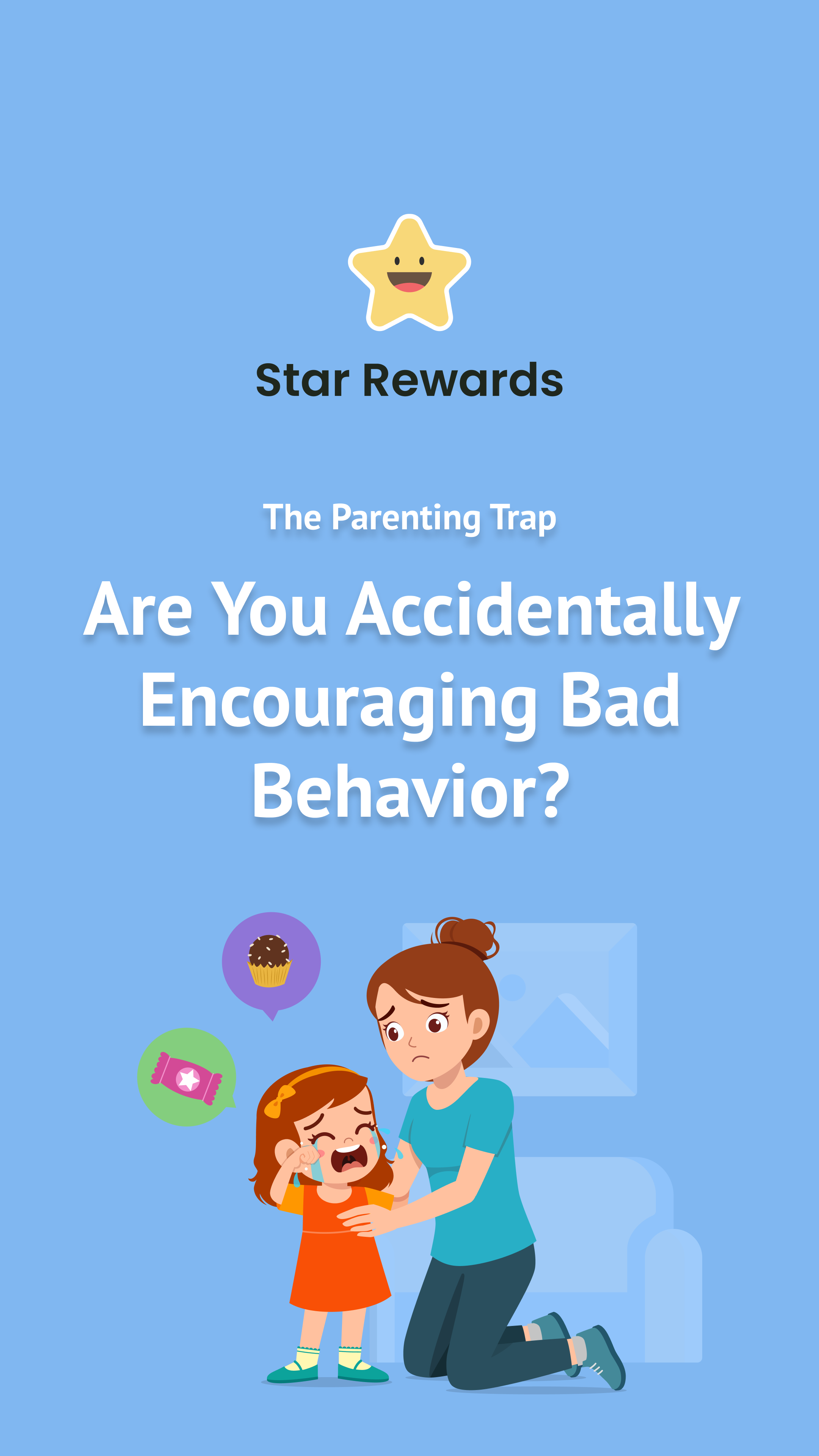
Picture this: You’re at the grocery store, your cart is full, and you’re racing against the clock to get home and start dinner. Suddenly, your 7-year-old spots the candy aisle and launches into a full-blown tantrum. Exhausted and embarrassed, you give in and toss a chocolate bar into the cart. Peace at last… or is it?
If this scenario sounds familiar, you’re not alone. Welcome to the world of unintentional reinforcement – where our well-meaning actions as parents might actually be encouraging the very behaviors we’re trying to stop.
The Accidental Reward System: Understanding Unintentional Reinforcement
Remember those psychology classes you dozed through in college? Well, it’s time for a quick refresher on operant conditioning. Don’t worry; we’ll keep it simple!
Operant conditioning is all about how behaviors are strengthened or weakened by their consequences. In parent-speak? It means that what happens after your child does something can make them more or less likely to do it again.
Here’s where it gets tricky: Sometimes, we accidentally reward negative behaviors without even realizing it. This is what we call unintentional reinforcement, and it comes in several flavors:
- Attention: Even negative attention can be reinforcing for some kids.
- Verbal responses: Arguing or reasoning with a misbehaving child might actually encourage the behavior.
- Physical comfort: Soothing a child after a tantrum could inadvertently reward the outburst.
- Avoidance of tasks: Letting a child skip chores due to complaints reinforces the whining.
Dr. Emily Carter, child psychologist, explains: “Parents often respond to negative behaviors out of love or a desire to avoid conflict. But these responses can sometimes send the wrong message to children about what behaviors are effective in getting their needs met.”
When Good Intentions Backfire: Common Scenarios
Let’s look at some everyday situations where unintentional reinforcement often occurs:
- Tantrums in public: Giving in to demands to avoid embarrassment.Sarah, mom of 6-year-old twins, shares: “I used to buy my kids toys every time we went to the store just to keep them quiet. It took me months to realize I was teaching them that screaming gets them what they want.”
- Whining for items: Purchasing requested items to stop the whining.
- Sibling rivalry: Paying more attention to the misbehaving child.Research shows that parental responses significantly impact children’s behavior. A study on children with conduct problems found that positive reinforcement can have different effects depending on the child’s characteristics [2].
- Bedtime resistance: Extending bedtime routines or allowing children to stay up later.
The Ripple Effect: Why It Matters
You might be thinking, “So what if I give in occasionally? It’s not that big a deal, right?” Well, the science says otherwise. Unintentional reinforcement can lead to:
- Increased frequency of negative behavior
- Escalation of intensity (if mild behaviors don’t work, children may escalate)
- Learned manipulation
- Difficulty in behavior correction
A study on elite youth athletes found that parental practices, including reinforcement, were associated with psychological skills and performance levels in sport [1]. This suggests that our parenting behaviors can have far-reaching effects on our children’s development and performance in various areas of life.
Breaking the Cycle: Strategies for Success
Now that we’ve identified the problem, let’s talk solutions. Here are some research-backed strategies to help you avoid the unintentional reinforcement trap:
- Planned ignoring: This doesn’t mean neglect! It’s about consciously withholding attention for minor misbehaviors.How to do it: When your child engages in attention-seeking behavior, avoid eye contact, don’t respond verbally, and continue with what you were doing. Be prepared for the behavior to intensify briefly before it improves.
- Consistent response: Maintain a uniform approach to negative behaviors.Tip: Create a behavior chart with your child, outlining expected behaviors and consequences. Stick to it consistently, even when it’s tough!
- Positive attention for good behavior: Actively reinforce desired behaviors.Try this: Set a timer to go off randomly throughout the day. When it does, catch your child being good and offer specific praise.
- Clear communication of expectations: Ensure children understand behavior rules.Make it fun: Create a family ‘rule book’ together, illustrating expected behaviors and rewards.
Research on kindergarten students found that parent-reported positive parenting practices were associated with fewer teacher-reported conduct problems [6]. So these strategies really do work!
Age Matters: Tailoring Your Approach
Just as you wouldn’t expect a 5-year-old to do calculus, you can’t apply the same behavior management strategies to all age groups. Here’s a quick guide:
- 5-7 years: Focus on clear, simple rules and immediate consequences (both positive and negative).
- 8-10 years: Introduce more complex reasoning about behavior and its effects on others.
- 11-12 years: Begin involving children in setting their own behavior goals and consequences.
A study on health care providers’ interventions found that age-appropriate strategies are crucial for effective behavior management [4].
When to Wave the White Flag (and Call in the Pros)
Sometimes, despite our best efforts, we need a little extra help. Consider seeking professional guidance if:
- Negative behaviors persist despite consistent use of positive parenting strategies
- Your child’s behavior is causing significant disruption at home or school
- You’re feeling overwhelmed or unable to cope with your child’s behavior
Remember, seeking help is a sign of strength, not weakness. A study on residential treatment for troubled adolescents found that while many behaviors improved with professional intervention, some issues required ongoing support [3].
Wrapping It Up: You’ve Got This!
Parenting is tough, and we all make mistakes. The key is to recognize when we might be unintentionally reinforcing negative behaviors and to have strategies to course-correct.
Dr. Carter encourages, “Every interaction with your child is an opportunity to shape their behavior positively. Be patient with yourself as you learn these new skills. Remember, progress, not perfection, is the goal.”
So, the next time you’re tempted to give in to that tantrum in the grocery store, take a deep breath and remember: You’re playing the long game. Your future self (and your future teenager) will thank you!
Ready to break the cycle of unintentional reinforcement? Start by choosing one strategy from this article to implement this week. Share your experiences in the comments below – we’re all in this together!
Additional Resources:
- “How to Talk So Kids Will Listen & Listen So Kids Will Talk” by Adele Faber and Elaine Mazlish
- The American Academy of Pediatrics (www.aap.org) offers a wealth of parenting resources
- Consider joining a local parenting support group or workshop for hands-on guidance and peer support
Remember, you’re not just raising a child; you’re raising a future adult. Every small step you take towards positive reinforcement is an investment in your child’s future. You’ve got this, super parent!
Leave a Reply